Answers from our own content
Anyone who visits an agency website usually has a concrete question: Does the service suit their own project? Are there comparable projects? How does the collaboration work?
On our website, an AI search helps with this. It answers with texts from the pages and articles of this website and with answers that we have written ourselves – nothing beyond that.
An example: asked “How does the collaboration with you work?”, the search shows an answer we have written ourselves. It names the central contact person and describes how we handle coordination, interim results and changes in the project. Below it, visitors find a further link to the page How we work, where this is described in more detail.
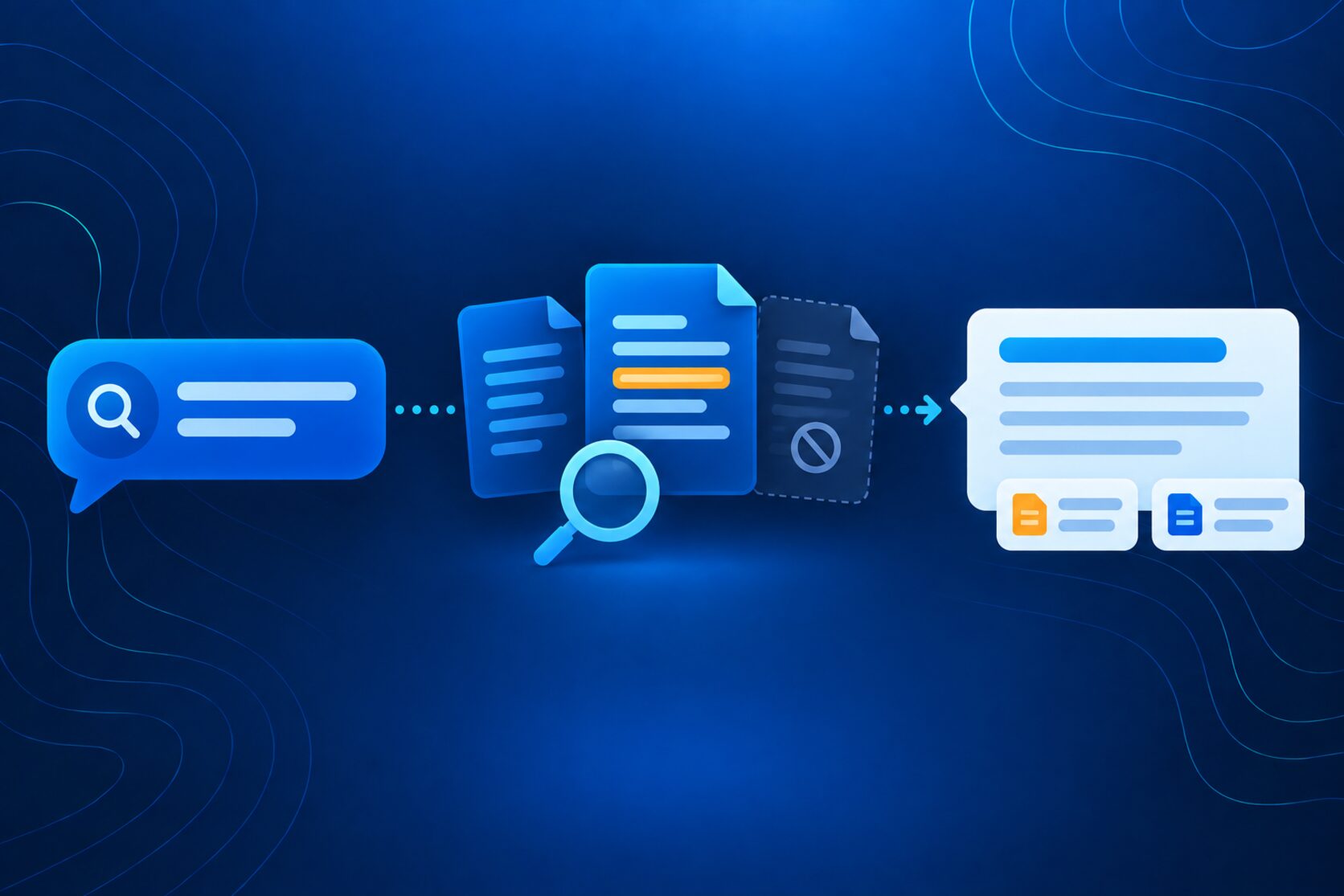
We store such fixed answers for important topics such as collaboration, prices or availability. What the AI adds becomes clear in comparison with a purely rule-based chatbot: there, questions are often assigned via predefined rules or dialogue paths. Our search also assigns freely worded questions to suitable texts on our website according to their meaning and takes into account what came before when follow-up questions are asked. The AI only selects; it does not formulate new statements. Assignment by meaning and taking follow-up questions into account are only available with your consent. Without consent, the keyword search remains available; a fixed answer then appears if the question matches one of the sample questions stored for it.
For visitors, this means: they can ask their question in their own words and need to know neither the right search term nor the right subpage. This makes it easier to find information that fits their question. Below each answer it says whether we wrote it (“Written by HMH”) or whether the AI selected it from texts on our website (“From our texts, selected by AI”).
It is important to us that the answers fit the question, are transparent and show their limits.
The AI selects, it does not formulate
In first tests, we saw that convincingly worded answers can still contain incorrect information: plausible phone numbers that did not exist, or reference clients we had never worked for.
That is why we decided not to let the AI write its own answers. It selects suitable sections from our website content and the answers we have prepared. These texts are displayed unchanged. This is a deliberate trade-off: freely worded answers could respond to every question more fluently. For information about our services, processes and prices, it matters more to us that every statement comes from us and that we can stand behind it.
This prevents the model from inventing additional information while formulating. Nevertheless, it can select a text that does not fit the question.
If nothing fits the question, we say so. We then show pages that come closest to the topic and invite a conversation. For us, missing information on the website does not mean that we do not offer a service or have no experience with it. That is why the search does not deny anything that is merely not described.
Sources and prepared answers
If an answer comes from a website page, we show the matching source. In addition, we use answers from our editorially maintained knowledge base: we formulate and maintain important information, for example on services, prices, processes and availability, ourselves. Further links below an answer are a reading recommendation, not evidence for every statement.
Whether a prepared answer fits a question is not decided solely by a single keyword, but above all by the meaning of the question. For this, we store sample questions for each answer. This assignment can also be off the mark; if we change content or tests reveal gaps, we revise answers and examples.
Follow-up questions in the conversation
For follow-up questions such as “And what does that cost?”, the search takes the previous course of the conversation into account. Changes of topic should also be recognised correctly. The system must not replace missing information with assumptions. In doing so, the search only takes into account earlier answers that actually came from it.
Only with your consent
The AI selection is only activated with your consent to the “AI search” category in the cookie settings. For this, we transmit your question to an external AI service. Without consent, you can still search the website using the keyword search; the chat window remains switched off and shows how to switch it on. Which provider is used and which data is processed is explained in our privacy policy.
When the AI service is unavailable
An AI function depends on an external service. If it is temporarily unavailable or our usage limit has been reached, the classic search remains available. Prepared answers that are assigned without AI can also still be displayed. Where this is not possible, visitors receive a notice and suitable pages to read on.
How we test
We test individual questions as well as coherent conversations. We check whether the answers fit, follow-up questions are assigned correctly and changes of topic work. After changes, we repeat the tests so that errors that have already been fixed do not reoccur. Because a language model does not select the same way every time, we ask questions several times and evaluate the worst run.
Which websites is this suitable for?
Whether such a search makes sense for a website depends on the existing content and the questions of its visitors. The more services or projects requiring explanation a website describes, the more likely it is to be worthwhile. How we proceed is described under AI and automation. If you would like to try the search yourself: the magnifying glass in the header of every page opens it.